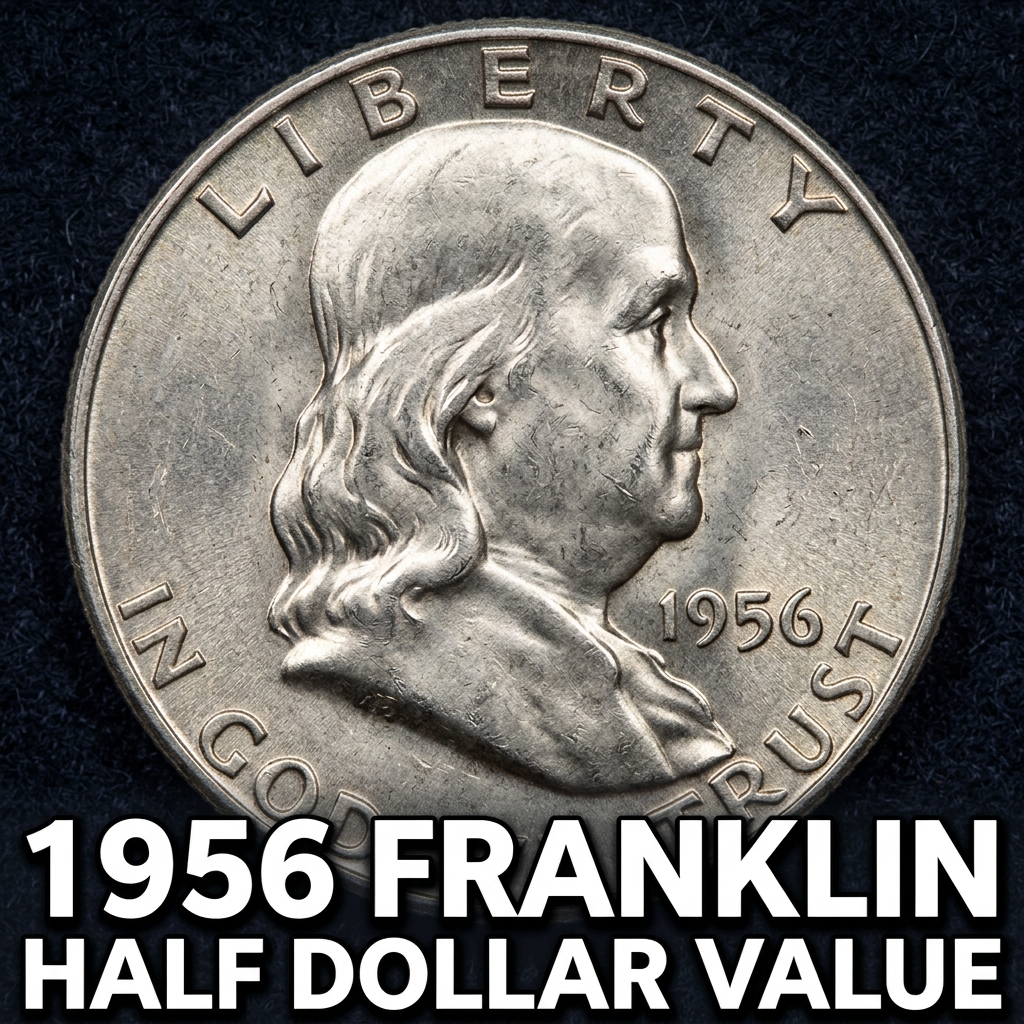
The 1956 Franklin Half Dollar is worth anywhere from $12 in worn condition to over $15,000 in exceptional proof condition. Whether you found one in a relative’s old jar or inherited a small collection, these heavy silver coins are a nostalgic piece of American history that still holds significant financial value today.
History and Composition of the 1956 Benjamin Franklin Silver Half Dollar
The 1956 Franklin Half Dollar is part of a series that ran from 1948 to 1963, featuring the bust of Founding Father Benjamin Franklin on the obverse and the Liberty Bell on the reverse. Many Americans are surprised to learn that these coins are made of 90% silver and 10% copper. Because of this high silver content, every 1956 half dollar has a “melt value” that fluctuates with the precious metals market, ensuring it is always worth much more than its 50-cent face value.
If you are unsure if your coin is a genuine silver piece or a later copper-nickel version, using a best coin identifier app can help you confirm the date and variety instantly. In 1956, the United States Mint in Philadelphia produced over 4 million circulation strikes and nearly 670,000 proof coins. Because these were common in the mid-50s, many survived in decent condition, but finding one in “Mint State” is where the real money lies. To keep track of your finds, you can use CoinHix, which allows you to catalog your collection and monitor market trends.
Differentiating Between Business Strikes and Proof Coins
When determining your coin’s worth, you must first identify if you have a “Business Strike” (meant for spending) or a “Proof” (meant for collectors). In 1956, all half dollars were minted in Philadelphia, meaning they do not have a mint mark. Business strikes usually have a satin-like luster and may show scratches from bumping into other coins in bags.
Proof coins, however, were struck twice using specially polished dies, resulting in a mirror-like finish. Because 1956 was a year of high-quality proof production, collectors pay a premium for “Type 1” and “Type 2” variations. The Type 1 has less detail on the eagle’s feathers, while the Type 2 features sharp, crisp details. Checking the latest 1956 Franklin half dollar price data is essential because the difference between these types can equal hundreds of dollars in professional auctions.
1956 Franklin Half Dollar Value Chart
To get a better idea of what your coin might be worth, refer to the pricing table below. Please keep in mind that these prices are estimates based on recent auction records and professional grading standards.
| Condition / Grade | Estimated Value (Business Strike) | Estimated Value (Proof) |
|---|---|---|
| Good to Very Fine (Circulated) | $12 – $15 | N/A |
| About Uncirculated (AU58) | $18 – $22 | N/A |
| Mint State (MS63) | $30 – $45 | N/A |
| Mint State (MS65) / Proof (PR65) | $100 – $150 | $65 – $85 |
| High Grade (MS66+ / PR69) | $500+ | $1,000 – $3,000+ |
The “Full Bell Lines” and Key Value Factors
The most sought-after feature on a business-strike 1956 Franklin Half Dollar is known as “Full Bell Lines” (FBL). If the horizontal lines at the bottom of the Liberty Bell are crisp, complete, and uninterrupted by scratches or weak strikes, the coin’s value skyrockets. An MS66 FBL specimen is a true rarity that can fetch thousands of dollars at elite auction houses.
Beyond the bell lines, the color and “toning” of the silver matter. Some 1956 halves develop a beautiful rainbow patina over time, which adds “eye appeal” and increases the price. When you are assessing your coins at home, avoid cleaning them, as this destroys the natural surface and halves the value instantly. Instead, use the CoinHix app to take a high-resolution photo and get a second opinion on the grade. Understanding the market value for 1956 Franklin half dollars in top-tier condition will prevent you from accidentally selling a treasure for just its silver weight.
Tips for Selling and Protecting Your Coin
If you decide you want to sell your 1956 Franklin Half Dollar, focus on finding a reputable local coin shop or a certified online auction platform. For high-value coins, consider getting them professionally graded by services like PCGS or NGC. A slabbed and certified coin is much easier to sell and often brings a significantly higher price than an “unfiltered” coin.
While waiting to sell, store your silver halves in PVC-free flips or capsules. Humidity and oils from your fingers can cause “milk spots” or ugly oxidation. If you have a large collection, CoinHix serves as an excellent digital inventory tool to track which coins have been protected and which ones are ready for professional appraisal.
Frequently Asked Questions
Q: Where is the mint mark on a 1956 Franklin Half Dollar?
A: In 1956, all Franklin Half Dollars were produced at the Philadelphia Mint. At that time, Philadelphia did not use a mint mark, so if you look above the Liberty Bell on the reverse and see no letter, it is a 1956-P.
Q: Is my 1956 half dollar made of real silver?
A: Yes, all Franklin Half Dollars minted between 1948 and 1963 are 90% silver. They contain approximately 0.3617 ounces of pure silver, making them valuable even if they are heavily worn or damaged.
Q: What is the rarest 1956 Franklin Half Dollar?
A: The rarest versions are Proof coins with “Deep Cameo” (DCAM) contrast, where the portrait of Franklin looks frosted and white against a black mirror background. These can sell for over $10,000 in PR68 or PR69 condition.