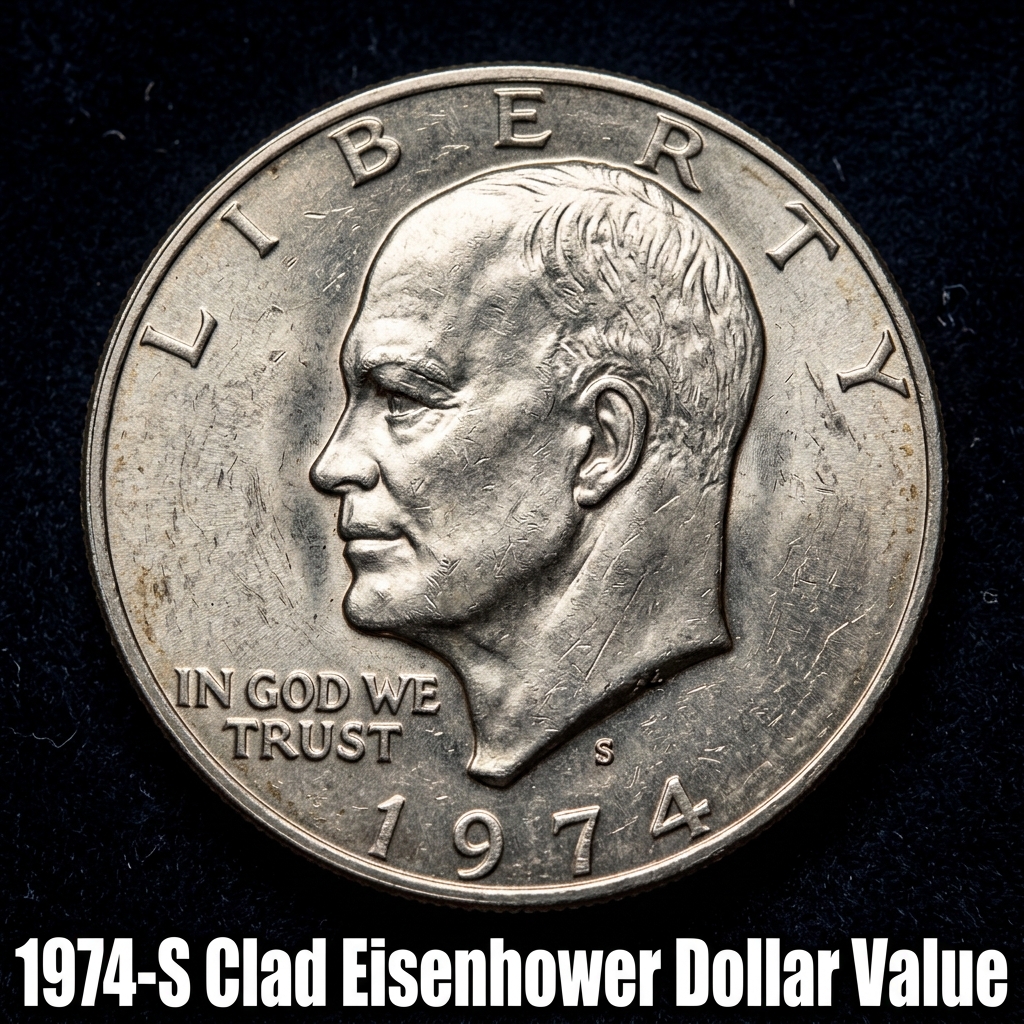
The 1974-S Clad Eisenhower Dollar is worth anywhere from its face value of $1 in circulated condition to over $5,000 for rare high-grade specimens. While most Ike dollars you find in change are common, certain “S” mint mark versions from 1974 hold significant value for collectors and history buffs alike.
Understanding the 1974 S Copper Nickel Clad Variety
Finding an Eisenhower dollar with an “S” mint mark usually suggests you have found something intended for collectors rather than general circulation. In 1974, the San Francisco Mint produced two distinct versions of the dollar: a 40% silver version and a copper-nickel clad version. The clad variety is what we refer to as the “non-silver” collector coin. These were primarily sold in United States Proof Sets, featuring a deep, mirror-like finish and highly detailed strikes.
If you are unsure which version you have held in your hand, using the best coin identifier app can help you distinguish between the silver and clad compositions instantly. Many people assume every large dollar coin is made of silver, but the 1974-S clad dollar is actually composed of a copper core sandwiched between layers of cupro-nickel. While they weren’t meant for spending at the grocery store, many have found their way into the public’s hands over the decades. If you have a handful of these, you might want to check the CoinHix app to log your collection and track price fluctuations.
What Determines the 1974 S Eisenhower Dollar Value
The value of a 1974-S clad dollar is almost entirely dependent on its “Grade”—the physical condition of the coin. Since these coins were minted as Proofs (specially made for collectors), they are expected to be shiny and free of scratches. A 1974-S clad dollar that has been handled, scratched, or spent in a vending machine usually loses its premium and settles near its $1 face value. However, coins that have remained in their original plastic packaging can fetch much more.
Professional grading services like PCGS or NGC use a 70-point scale to rank these coins. Deep Cameo (DCAM) designations are particularly sought after, as they feature a sharp contrast between the frosted portrait of Ike and the mirror-like background. For a precise breakdown of how condition affects the market rate, you can view the 1974-S clad Ike dollar auction price data which shows that top-tier grades can command thousands of dollars at major auctions.
1974 S Clad Eisenhower Dollar Price Comparison Table
To give you a better idea of what your coin might be worth, refer to the table below. These prices represent average market values for the copper-nickel clad Proof versions.
| Condition / Grade | Estimated Value |
|---|---|
| Circulated / Impaired Proof | $1.00 – $1.50 |
| Proof 65 (Typical Collector Grade) | $10.00 – $15.00 |
| Proof 69 Deep Cameo (Near Perfect) | $40.00 – $65.00 |
| Proof 70 Deep Cameo (Perfect Condition) | $3,500 – $5,500+ |
How to Spot Rare Errors or High-Value Varieties
While the standard 1974-S clad dollar is affordable, collectors are always on the hunt for “condition rarities.” A condition rarity is a coin that is common in low grades but nearly impossible to find in “perfect” Proof 70 condition. Because the 1974-S clad Proofs were minted in a high volume (over 2.6 million), only those without a single microscopic flaw reach the highest price points. You should also look for “double die” errors, where the lettering or the date appears to be doubled.
If you find a coin that looks exceptionally perfect, it might be worth sending it to a professional for authentication. Before spending money on grading fees, however, many hobbyists use the CoinHix app to compare their coin against high-resolution images of known rarities. Staying informed on detailed 1974 dollar coin value information is the best way to ensure you don’t accidentally spend a coin that could pay for a vacation.
Keeping Your Eisenhower Dollars Safe
If you’ve discovered that your 1974-S clad dollar is in excellent condition, you must protect it from the elements. Oils from your skin can cause “toning” or spotting on the surface, which can drastically lower the grade. Always handle your coins by the edges and store them in PVC-free plastic holders or flips.
For many American families, these large “Ike” dollars are a nostalgic bridge to the past. Whether you are keeping it for sentimental reasons or looking to sell, knowing the current market value is essential. Using tools like CoinHix can help you keep an organized digital inventory of your finds, making it easier to see how your collection grows in value over time.
Q: Is the 1974-S Clad Eisenhower Dollar made of silver?
A: No, the “Clad” version is made of copper and nickel. However, the San Francisco Mint also produced a 40% silver version in 1974. You can tell the difference by looking at the edge of the coin; if you see a copper-colored stripe, it is clad.
Q: Where is the mint mark on a 1974 Eisenhower Dollar?
A: The mint mark is located on the obverse (front) of the coin, just above the date and below the neck of President Dwight D. Eisenhower. An “S” indicates it was minted in San Francisco.
Q: Are 1974-S Clad dollars rare?
A: They are not rare in circulated or typical Proof condition, as millions were produced for collectors. However, they are extremely rare and valuable in “Perfect” Proof 70 condition.