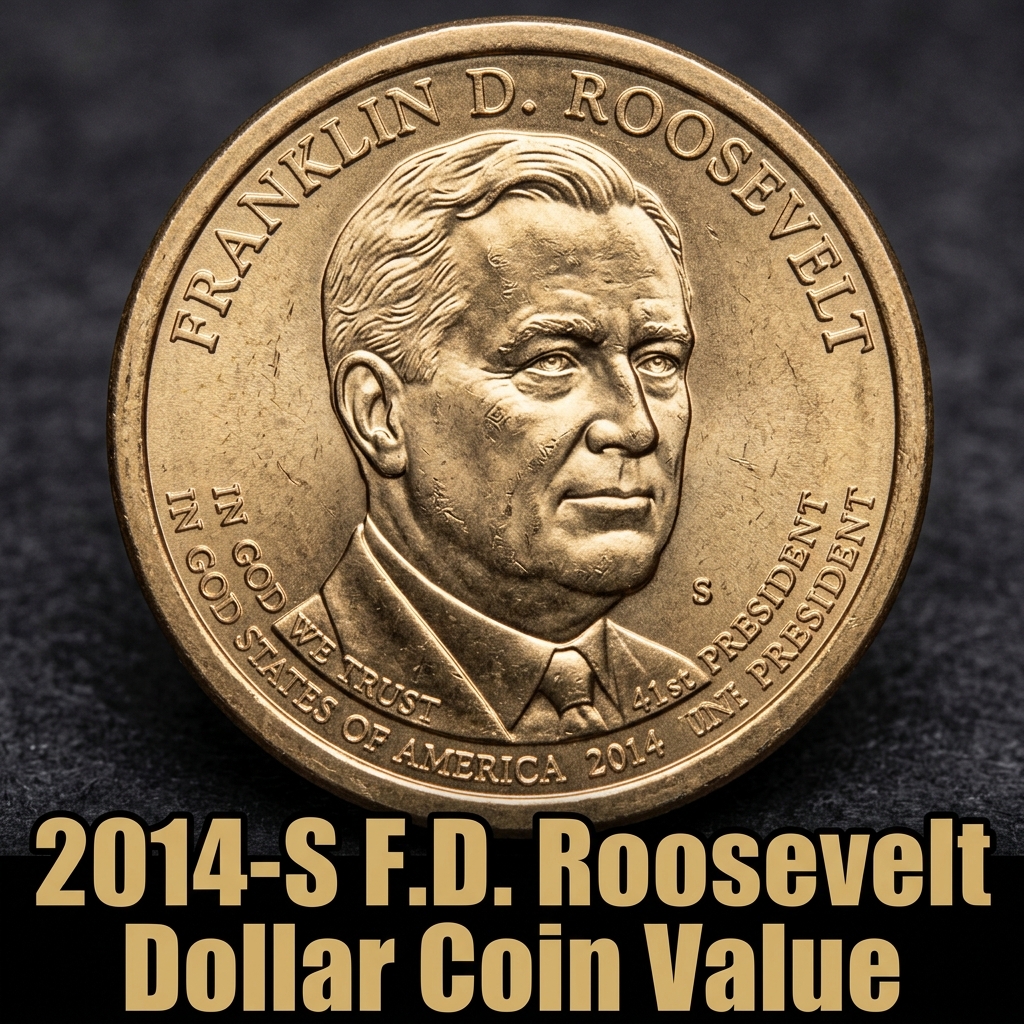
The 2014-S F.D. Roosevelt Dollar Coin is worth anywhere from $5 in typical proof condition to over $45 in high-grade Deep Cameo sets. If you recently found one of these shiny, gold-colored coins in a collection or a drawer, you are likely looking at a special “Proof” strike intended for collectors rather than daily spending.
The History and Unique Design of the 2014-S Franklin D. Roosevelt Dollar
The 2014 F.D. Roosevelt dollar was released as part of the United States Mint’s Presidential $1 Coin Program, which honored each U.S. President in the order they served. This specific coin celebrates Franklin Delano Roosevelt, the 32nd President, who led the nation through the Great Depression and World War II. While billions of standard quarters and dimes circulate every year, these presidential dollars are a bit more elusive to the average person. If you aren’t sure exactly which version you have, utilizing the best coin identifier app can help you distinguish between a standard business strike and an “S” mint mark proof.
The “S” mint mark signifies that the coin was produced at the San Francisco Mint. Unlike the coins you find in your pocket change, these were struck twice with polished dies to create a mirror-like background and frosted details. Because they were sold in official sets by the U.S. Mint, they were never intended for circulation. However, many sets have been broken up over the years, leading some of these coins to find their way into private hands. Identifying these coins quickly is easy when you use the CoinHix app, which can scan the details of the coin and give you an instant identification of its mint origin.
Understanding the Market Value and Condition of Your 2014-S Dollar
When determining value, condition is the most critical factor for a collector. Since nearly all 2014-S Roosevelt dollars started in protected plastic cases, they are expected to be in “Proof” condition. However, if the coin has been handled or scratched, its value drops significantly. For those looking for precise market data, the current market value for 2014 dollar strikes shows that even minor imperfections can change the price by several dollars. Most collectors look for coins graded PR69 or PR70, which represent near-perfection.
The 2014-S Proof coins are usually sold as part of a 4-coin Presidential Proof Set or a full 14-piece Silver or Clad Proof Set. If you have a loose coin that looks perfectly reflective, it is likely a “Deep Cameo” (DCAM). This means there is a heavy contrast between the shiny field and the frost-white portrait of FDR. To get a better sense of how these compare to other years in the series, you can check the 2014 Presidential dollar price information to see how the San Francisco mintages stack up against Philadelphia and Denver releases.
2014-S F.D. Roosevelt Dollar Price Comparison Chart
To help you understand what your coin might be worth at a coin shop or online auction, refer to the table below. Please note that these prices are estimates based on “Deep Cameo” proof standards, which is the most common state for the 2014-S issue.
| Coin Grade / Condition | Estimated Market Value |
|---|---|
| PR 65 (Standard Proof) | $4.50 – $6.00 |
| PR 68 Deep Cameo | $8.00 – $12.00 |
| PR 69 Deep Cameo | $15.00 – $22.00 |
| PR 70 Deep Cameo (Perfect Grade) | $40.00 – $65.00 |
What Makes This Coin Special and How to Store It
The 2014-S Roosevelt dollar is composed of a copper core with a manganese-brass cladding. This gives it the characteristic “Golden” look, though it contains no actual gold. One of the most unique features of this series is the edge-incused lettering. Unlike the ridges you find on a dime or quarter, the date, mint mark, and “E Pluribus Unum” are engraved directly into the smooth edge of the coin. If you find one where the edge lettering is missing, you could have a rare and valuable error coin worth hundreds of dollars.
To keep your 2014-S coin at its peak value, you must avoid touching the surface with your bare fingers. The oils from your skin can cause “toning” or cloudiness on the mirror finish over time. Serious collectors use CoinHix to organize their digital inventory and ensure they are tracking the growth of their collection’s value. Storing your dollar in a PVC-free plastic flip or a specialized coin album is the best way to prevent scratches that could downgrade a PR70 coin down to a PR65.
Comparing the 2014-S to Other Presidential Dollars
By 2014, the U.S. Mint had stopped producing Presidential Dollars for general circulation. This means that the total mintage for 2014 coins is much lower than the earlier years of the program, like the 2007 Washington or 2008 Adams dollars. Because they were made primarily for collectors, the 2014-S F.D. Roosevelt dollar is generally considered more “scarce” than the earliest coins in the series. If you use the CoinHix app to compare mintages, you’ll see that the San Francisco Proof mintage is a fraction of the coins produced in the first few years of the program.
Collectors often seek out the Roosevelt dollar because he is one of the most popular presidents in American history. While the coin is not currently worth thousands of dollars, it is a staple for anyone trying to complete a full set of 20th-century presidential honors. Whether you are a beginner or an experienced numismatist, checking your coins against professional archives and keeping them in high-quality holders will ensure that their value remains stable or grows as these sets become harder to find on the open market.
Q: Is the 2014-S Roosevelt Dollar made of real gold?
A: No, the coin is made of a base metal composition consisting of a copper core coated in manganese brass, which gives it a golden appearance without any actual gold content.
Q: How can I tell if my 2014-S is a “Proof” coin?
A: A Proof coin will have a mirror-like, reflective background and very sharp, frosted details on the portrait. It will also feature an “S” mint mark on the edge of the coin.
Q: Can I find a 2014-S Roosevelt Dollar in my pocket change?
A: While it is possible if someone accidentally spent it, it is very rare. These coins were produced only for collectors and were sold in sets by the Mint, not released into general circulation.