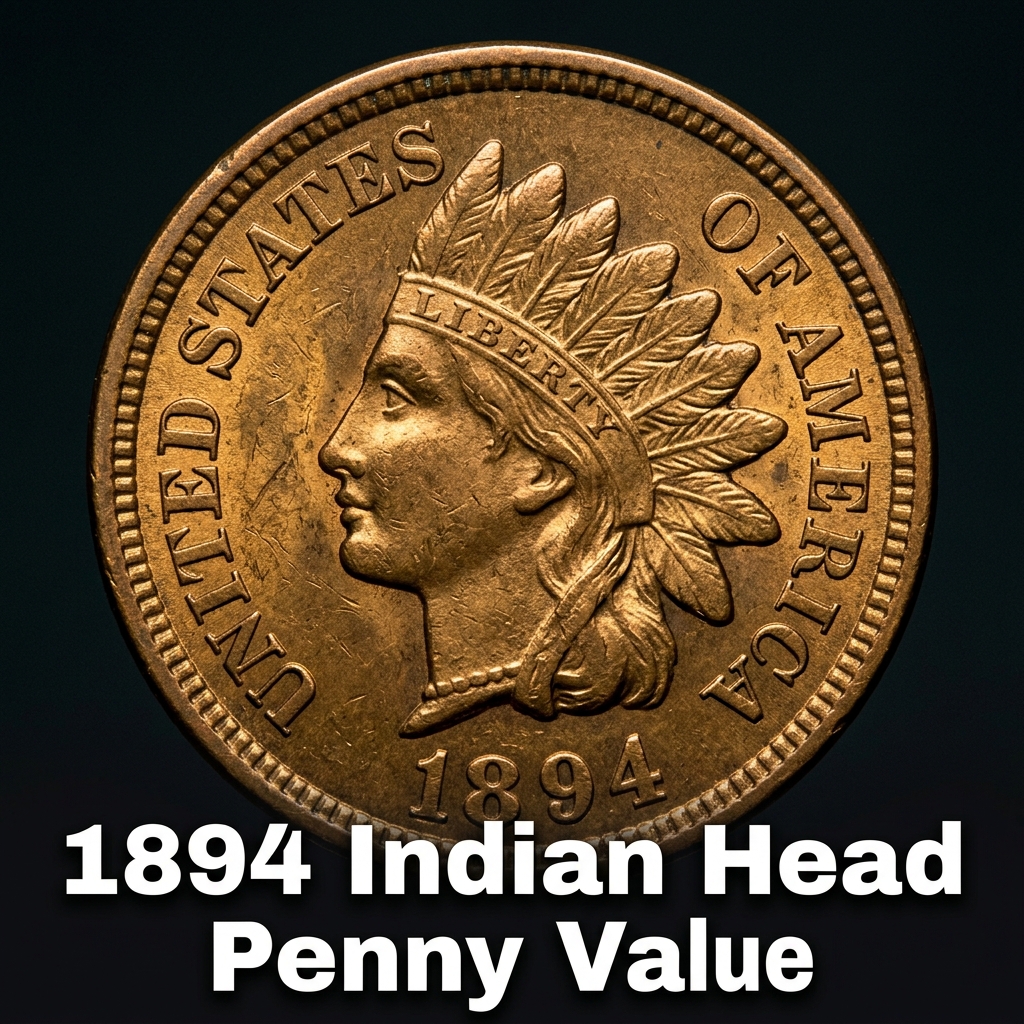
The 1894 Indian Head Penny is worth anywhere from $5 in worn condition to over $600 in pristine mint state. If you have discovered one of these classic copper coins in an old jar or inherited collection, you are holding a piece of American history from the late 19th century that still holds significant collector interest today.
Understanding the Scarcity of the 1894 Indian Head Cent
Finding an 1894 penny is an exciting moment for any casual treasure hunter. During this year, the Philadelphia Mint produced 16,749,500 business strike coins. While this sounds like a massive number, the survival rate of these coins in high grades is surprisingly low. Most of these pennies circulated heavily through the American economy, meaning they are often found with significant smoothing on Liberty’s feathers and the wreath on the reverse.
If you are unsure whether your coin is a common circulation find or a rare gem, using the best coin identifier app can help you zoom in on the specific details that define its grade. Collectors classify these coins based on “Red,” “Red-Brown,” or “Brown” color designations. A coin that retains its original mint luster is significantly more valuable than one that has turned a dull chocolate brown over the last century. To get a quick estimate on your smartphone, the CoinHix app provides instant visual recognition to help you start your valuation journey.
Current Market Prices for 1894 Indian Head Pennies
The value of your 1894 penny depends almost entirely on its condition, also known as its “grade.” Most coins found today fall into the “Good” to “Fine” categories, where the design is visible but lacks fine detail. However, if you find a coin that looks like it never spent a day in a pocket, the value skyrockets. Professional collectors often look for the 1894 Indian Head Penny MS RD value to see what top-tier specimens are selling for at modern auctions.
Because there were no mint marks used in 1894 (all were struck in Philadelphia), you don’t need to look for tiny letters under the wreath. Instead, focus on the sharpness of the word “LIBERTY” on the headband. If all seven letters are clearly visible, your coin is likely in “Very Fine” condition or better. For those comparing different years of this era, you might also be interested in the 1898 Indian Head Penny value information to see how prices fluctuate across the 1890s series.
| Condition / Grade | Estimated Market Value |
|---|---|
| Good (G-4) | $5.00 – $8.00 |
| Fine (F-12) | $15.00 – $22.00 |
| Extra Fine (EF-40) | $45.00 – $60.00 |
| Uncirculated (MS-63 Brown) | $110.00 – $150.00 |
| Uncirculated (MS-65 Red) | $650.00+ |
| Proof 65 | $850.00+ |
Key Varieties and Errors to Watch For
While most 1894 pennies are standard issues, there are a few “cherrypicker” varieties that can turn a $10 coin into a $100 coin. The most well-known variety for this year is the “1894/1894” Doubled Die Obverse. If you look closely at the date with a magnifying glass, or use the high-resolution scanning feature on CoinHix, you might see clear doubling on the numbers. This occurs when the die used to strike the coin was hubbed twice, leaving a ghost-like secondary image.
Another interesting aspect of the 1894 issue is the Proof version. The Mint produced 2,632 Proof coins specifically for collectors. these coins have a mirror-like finish and sharp, square edges. If your penny looks incredibly shiny and the details are exceptionally crisp, it might be a proof strike. These are highly sought after and often fetch nearly a thousand dollars if they have been preserved in protective holders.
How to Safely Store Your Antique Pennies
Once you have identified your 1894 Indian Head Penny using the CoinHix app, it is vital to preserve its condition. Copper is a highly reactive metal that can darken or develop “green rot” (verdigris) if exposed to moisture or oils from your skin. Always handle your coins by the edges rather than touching the flat surfaces.
For storage, avoid using PVC-containing plastic flips, as the chemicals can damage the metal over time. Instead, use PVC-free “2×2” cardboard holders or hard plastic capsules. Proper storage ensures that the value of your 1894 penny remains stable or even increases as these historic coins become harder to find in the open market. Whether you’re a serious numismatist or someone who just likes finding history in their change, the 1894 cent is a rewarding coin to own.
Frequently Asked Questions
Q: Where is the mint mark located on an 1894 Indian Head Penny?
A: The 1894 Indian Head Penny does not have a mint mark. All business strike pennies from this year were minted at the Philadelphia Mint, which did not use mint marks on cents during that era.
Q: Is a cleaned 1894 penny worth more?
A: No, you should never clean your coins. Cleaning an 1894 penny with chemicals or abrasive cloths removes the original surface (patina) and can reduce the collector value by 50% or more. Collectors prefer coins with natural aging.
Q: How can I tell if my 1894 penny is a Doubled Die?
A: You will need a jeweler’s loupe or a high-magnification coin app to check the date. Look for a vertical line or “doubling” inside or around the “8” and “4” of the date. If the numbers look thicker or have clear secondary edges, it may be a valuable variety.