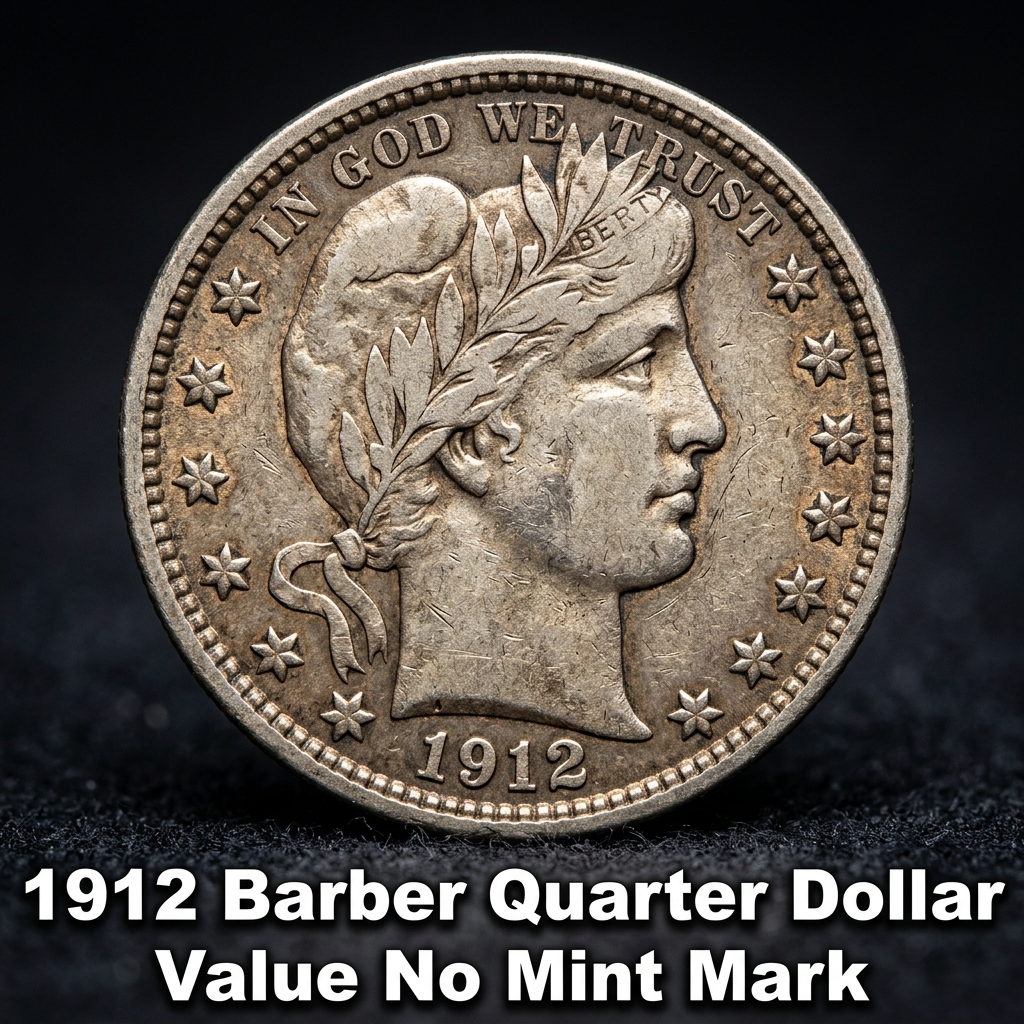
The 1912 Barber Quarter is worth anywhere from $8 in worn condition to over $600 in premium mint state. This classic silver coin is a staple of American history, and finding one in your pocket change or an old jar is an exciting discovery for any casual collector.
The History and Design of the 1912 Philadelphia Barber Quarter
The 1912 Barber Quarter is named after its designer, Charles E. Barber, who served as the Chief Engraver of the US Mint. This coin features a stoic Lady Liberty on the obverse, wearing a Phrygian cap and a laurel wreath. To the everyday observer, these coins represent a bygone era of American craftsmanship where currency was made of actual precious metal.
If your 1912 quarter has “no mint mark,” it means it was struck at the main Philadelphia Mint. In 1912, the Philadelphia Mint produced 4,400,000 of these quarters. While this might sound like a large number, millions were melted down or lost over the last century, making well-preserved survivors quite valuable today. To get an instant valuation of your specific coin’s condition, you can use the best coin identifier app to see high-resolution comparisons.
Many people who find these coins are surprised by their weight and “clink” sound. This is because the 1912 Barber Quarter is composed of 90% silver and 10% copper. Because of this silver content, the coin always has a “melt value” that acts as a price floor, even if the coin is heavily damaged. However, the numismatic (collector) value is almost always higher than the raw silver price. Using the CoinHix app can help you track these fluctuating market prices in real-time.
How Much Is a 1912 Quarter Worth Based on Condition
When determining the 1912 Barber Quarter value no mint mark, condition is the most significant factor. Professional numismatists use a 70-point scale to grade coins. For most “everyday” finds, your coin will likely fall into the Good, Very Good, or Fine categories. A coin in “Good” condition will show significant wear, with Liberty’s head appearing flat and the letters in “LIBERTY” on her headband being mostly invisible.
As you move up to “Fine” or “Very Fine” grades, you start to see the individual leaves in the wreath and more distinct lines in the hair. If you are lucky enough to find a coin with its original luster—meaning it looks shiny and uncirculated—the price jumps significantly into the hundreds of dollars. For those curious about how this era compares to other denominations, you can check the 1912 silver dime price guide to see how the market treats similar “no mint mark” coins from the same year.
To help you estimate what your coin might be worth, refer to the pricing chart below. These prices reflect current market averages for the 1912 Philadelphia (No Mint Mark) variety.
| Condition / Grade | Estimated Value (USD) |
|---|---|
| Good (G-4) | $8.50 – $12.00 |
| Very Good (VG-8) | $15.00 – $18.00 |
| Fine (F-12) | $25.00 – $35.00 |
| Very Fine (VF-20) | $55.00 – $75.00 |
| Extremely Fine (XF-40) | $110.00 – $140.00 |
| Uncirculated (MS-60+) | $250.00 – $650.00+ |
Where to Find the Mint Mark on Barber Quarters
Identifying where your coin was made is crucial for valuation. For the 1912 issue, there are three possibilities: Philadelphia (no mint mark), Denver (D), and San Francisco (S). To find the mint mark, look at the reverse (back) of the coin. Below the eagle’s tail feathers and just above the “R” and “T” in “QUARTER DOLLAR,” you will see a small letter or an empty space.
If that space is empty, you have the Philadelphia variety discussed in this article. If you see a “D,” it was struck in Denver, and an “S” indicates San Francisco. Interestingly, the 1912-S is much rarer and commands a higher price than the no-mint-mark version. If you are struggling to see these tiny details due to wear, the CoinHix app features a powerful zooming tool and AI recognition to help you spot these mint marks instantly.
Knowing the 1912 Barber Quarter value no mint mark helps you ensure you don’t accidentally spend a $50 coin for 25 cents. Always handle your coins by the edges and avoid cleaning them. Cleaning a vintage coin with chemicals or cloths can actually strip away its value by damaging the delicate surface of the silver, making it less desirable to serious collectors.
Key Factors Influencing Your Coins Resale Price
Beyond just the grade, several other factors can influence the 1912 Barber Quarter value no mint mark. Eye appeal is a major factor for buyers. A coin that has aged naturally with a beautiful “patina” or rainbow-like toning often sells for more than a dull, grey coin. Collectors love the look of history on a coin, provided it hasn’t been artificially altered.
Demand is another driver. Because the Barber Quarter series is part of a “type set” (where collectors try to get one of every design ever made), there is always a steady stream of buyers for 1912 quarters. If you’re thinking about selling, it’s a good idea to check recent auction results on the CoinHix platform to see what people are actually paying today, rather than just looking at “asking prices” on eBay which can be misleading.
Finally, remember that silver prices change every day. Since the 1912 quarter contains approximately 0.18 ounces of pure silver, its “junk silver” value will fluctuate. However, because this is a 110-year-old coin, its historical value almost always keeps it safely above the price of raw silver. Whether you are a seasoned collector or just someone who found a treasure in the attic, the 1912 Barber Quarter is a fascinating piece of American numismatics.
Q: Is a 1912 quarter with no mint mark rare?
A: While it is not the rarest in the series, it is considered scarce in high grades. Over 4 million were minted, but most served heavily in circulation, making coins in “Very Fine” or better condition quite hard to find today.
Q: Should I clean my 1912 Barber Quarter to make it look new?
A: No! You should never clean old coins. Cleaning leaves microscopic scratches that professional graders can easily spot, and it can reduce the collector value of your coin by 50% or more.
Q: Where is the best place to sell a 1912 Barber Quarter?
A: For common, circulated coins, a local coin shop or a reputable online marketplace is best. For high-value, uncirculated examples, you may want to consider professional grading and specialized numismatic auctions to get the highest price.