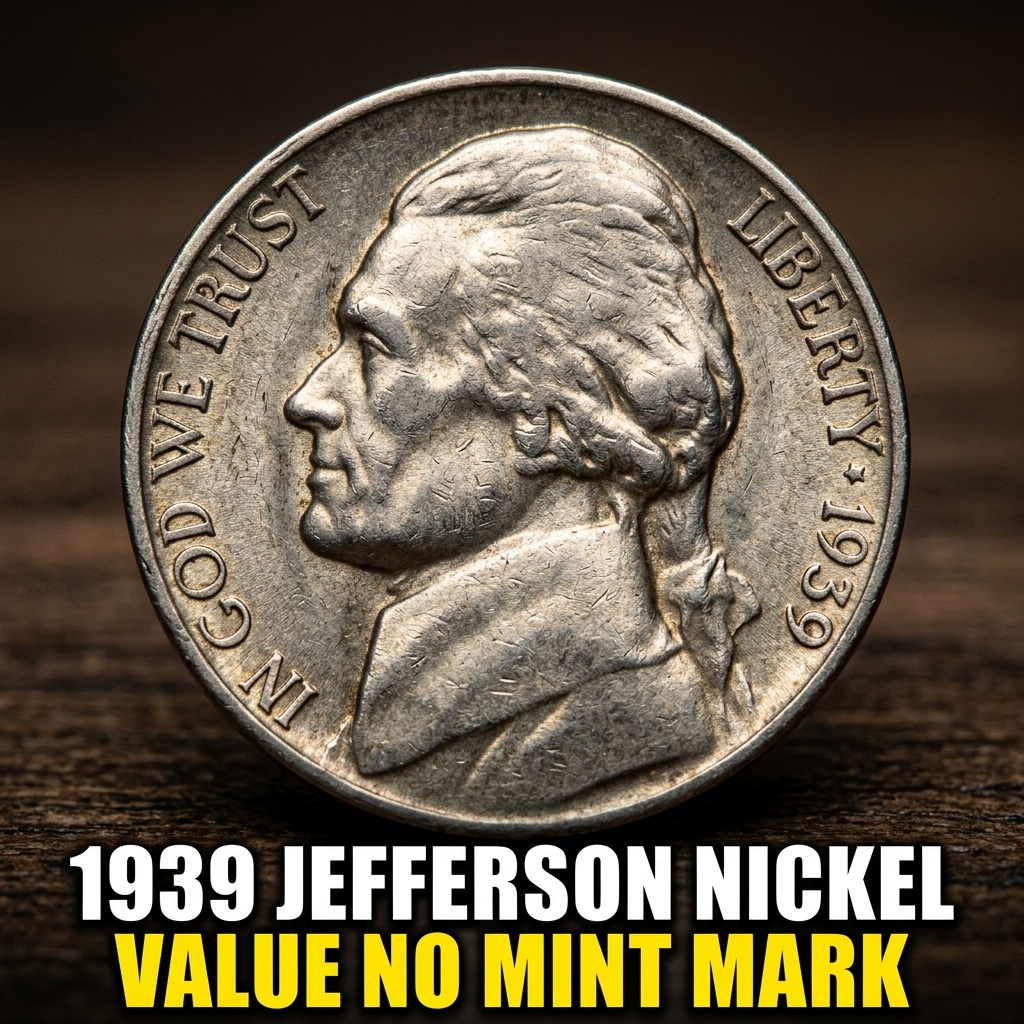
The 1939 Jefferson Nickel with no mint mark is worth anywhere from 10 cents in heavily worn condition to over $100 or more in top uncirculated grades — and a few special examples have sold for much higher at auction. If you found one of these old nickels in a coin jar, a drawer, or an old collection, you’re in the right place to find out exactly what it might be worth.
What Is the 1939 Jefferson Nickel with No Mint Mark?
The 1939 Jefferson Nickel was struck at the Philadelphia Mint, which is why it carries no mint mark. Philadelphia coins from this era didn’t use a mint mark — that was standard practice at the time.
This was only the second year of the Jefferson Nickel series, which launched in 1938. The coin features a portrait of Thomas Jefferson on the obverse and his famous home, Monticello, on the reverse. Felix Schlag designed both sides.
In 1939, the Philadelphia Mint produced 120,627,535 nickels — a large mintage, which is part of why circulated examples are fairly common and inexpensive. But high-grade uncirculated specimens are a different story entirely.
If you’re not sure whether you have a Philadelphia coin or something else, using the best coin identifier app can help you quickly confirm the mint mark location and coin details right from your phone.
1939 Jefferson Nickel Value by Grade
The condition of your coin makes a huge difference in value. A coin that’s been in circulation for decades will show wear on the high points — Jefferson’s cheekbone, hair details, and the steps of Monticello. Uncirculated coins that never saw pocket change are worth dramatically more.
Here’s a quick look at approximate values across different grades:
| Grade | Description | Estimated Value |
|---|---|---|
| Good (G-4) | Heavy wear, design visible | $0.10 – $0.25 |
| Fine (F-12) | Moderate wear, some detail | $0.35 – $1.00 |
| Extremely Fine (EF-40) | Light wear, sharp details | $2 – $5 |
| MS-63 (Uncirculated) | No wear, some contact marks | $15 – $30 |
| MS-65 (Gem Uncirculated) | Exceptional luster and strike | $60 – $120+ |
For the most current auction results and certified coin prices, you can check out detailed MS-grade price data for the 1939 Jefferson Nickel to see what collectors are actually paying right now.
What Makes a 1939 Jefferson Nickel More Valuable
Not all 1939 Philadelphia nickels are equal. A few factors can push a coin’s value significantly higher than average.
Full Steps designation is one of the biggest value drivers in Jefferson Nickels. When the steps of Monticello on the reverse are fully struck and show five or six complete, uninterrupted steps, the coin qualifies for an “FS” designation from major grading services like PCGS or NGC. A 1939 Jefferson Nickel graded MS-65 Full Steps can fetch several hundred dollars — a massive jump over a regular MS-65.
Strike quality and luster also matter. Some coins from this era came out weakly struck, which reduces their appeal to collectors. A boldly struck coin with vibrant original luster is much more desirable.
Eye appeal counts too. Toned coins with attractive natural patina can actually command a premium among collectors. Harsh cleaning, on the other hand, can drop a coin’s value dramatically.
CoinHix is a great tool to help you understand how these factors affect real-world prices — just search the coin in the CoinHix app and you’ll see graded examples with their sale prices right at your fingertips.
How to Check the Condition of Your 1939 Nickel
If you’ve pulled a 1939 Jefferson Nickel out of an old piggy bank or coin roll, here’s how to get a basic sense of its grade without being a professional numismatist.
First, look at Jefferson’s cheekbone and the hair above his ear. If that area is smooth and flat, the coin is circulated. If you can still see hair strands and sharp detail, you’re looking at an Extremely Fine or better coin.
Next, flip it over and look at Monticello’s steps. Count them. If you can see five or more complete, clearly defined steps with no breaks, that’s a promising sign of a Full Steps coin.
Never clean your coin — even a rinse can reduce its value. Handle it by the edges, and store it in a coin flip or soft sleeve.
For an easy way to identify what you have, CoinHix lets you scan coins and instantly pull up variety info, grade estimates, and price ranges. It’s a handy first step before deciding whether to get a coin professionally graded.
You can also check a full breakdown of 1939 nickel value by date and mint mark to compare your coin against other issues in the series and see where yours might fall in terms of rarity and worth.
FAQ
Q: Is a 1939 Jefferson Nickel with no mint mark rare?
A: Not particularly. Over 120 million were minted in Philadelphia that year, making circulated examples quite common. However, high-grade uncirculated coins — especially those with Full Steps — are genuinely scarce and worth real money to collectors.
Q: Should I get my 1939 Jefferson Nickel professionally graded?
A: It depends on the condition. If your coin looks uncirculated and the Monticello steps are sharp and complete, professional grading by PCGS or NGC could be worth the cost. A certified MS-65 Full Steps example can be worth hundreds of dollars. For worn coins, grading fees usually aren’t justified.
Q: Where is the mint mark on a 1939 Jefferson Nickel?
A: On 1939 Jefferson Nickels, the mint mark appears on the reverse of the coin, to the right of Monticello. Philadelphia coins have no mint mark. Denver coins show a “D” and San Francisco coins show an “S.” If you see nothing there, you have a Philadelphia coin.