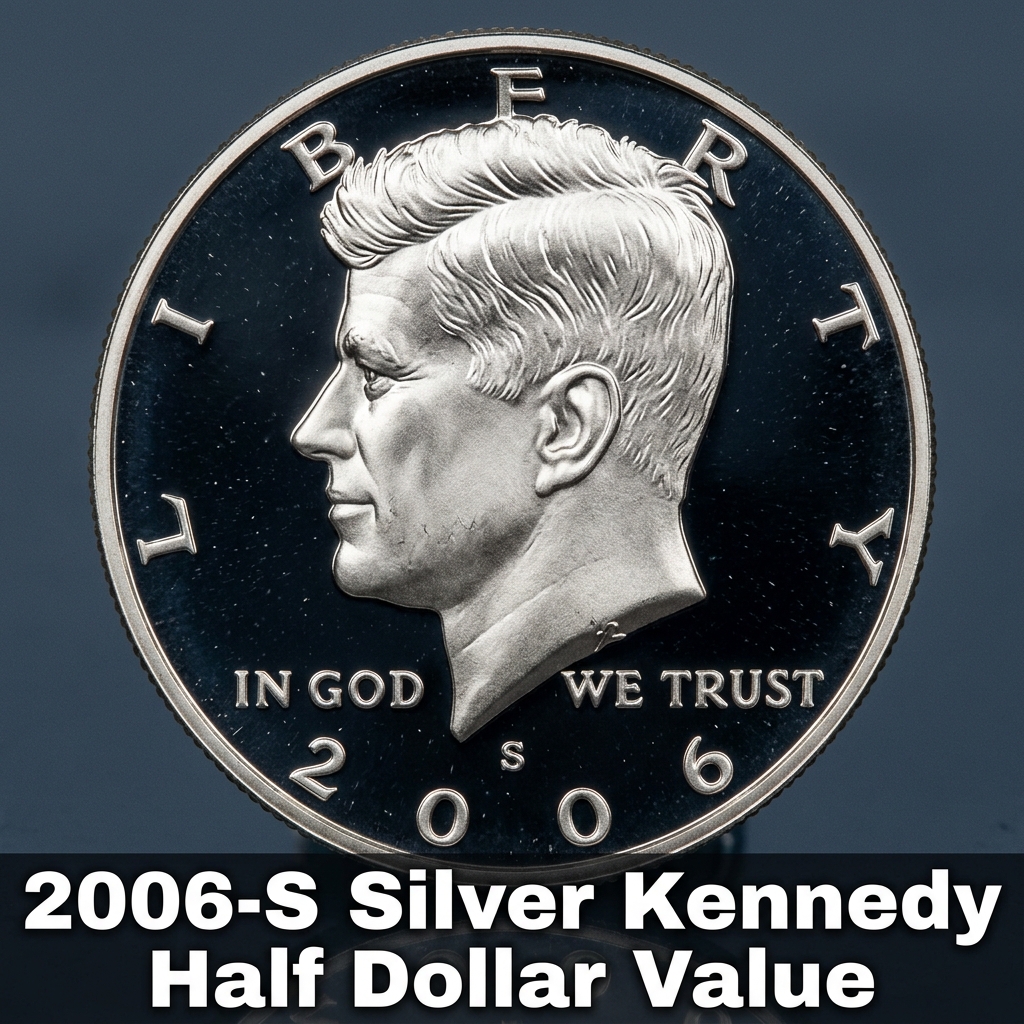
The 1970-D Kennedy Half Dollar is worth anywhere from $10 in circulated condition to over $5,000 for high-grade specimens. While most Kennedy halves from the late 60s are common, the 1970-D is a special “key date” that every collector and casual enthusiast hopes to find in their change.
| Condition / Grade | Estimated Value |
|---|---|
| About Uncirculated (AU50) | $10 – $15 |
| Mint State (MS63) | $25 – $40 |
| Mint State (MS65 Gem) | $60 – $100 |
| High Grade (MS67+) | $500 – $5,000+ |
Why the 1970-D Kennedy Half Dollar is Rare
When looking through a jar of old coins, you might assume all silver-colored half dollars are the same. However, the 1970-D Kennedy Half Dollar is an anomaly in U.S. coinage history. Unlike previous years, the Denver Mint did not release this coin into general circulation.
It was produced exclusively for the Annual Mint Sets. This means you wouldn’t have found one at the local grocery store in 1970. If you have one today, it likely came from a broken-up mint set or was inherited from a collector. Because of this restricted release, the mintage was incredibly low—only 2,150,000 were struck. If you are unsure if yours is the real deal, using the best coin identifier app can help you verify the mint mark and condition immediately.
For beginners, identifying this coin is straightforward. Look for the “D” mint mark just above the date on the obverse (front) of the coin. Because these were never intended for pockets, they often retain much of their original luster. If you find one that looks shiny and fresh, you might be holding a significant amount of money. To get an instant valuation, many users turn to CoinHix to see real-time market trends.
The Silver Content of the 1970-D Kennedy Half
One of the most important things to understand about the 1970-D Kennedy Half Dollar value is its composition. While the U.S. Mint stopped using 90% silver for quarters and dimes in 1964, the Kennedy Half Dollar continued to use “silver clad” composition until 1970.
This coin is made of 40% silver and 60% copper. Specifically, it consists of two outer layers of 80% silver and 20% copper, bonded to a core of approximately 21% silver and 79% copper. This gives the coin a total silver weight of about 0.1479 troy ounces. Even if the coin is scratched or damaged, it will always be worth its “melt value,” which fluctuates with the price of silver.
However, selling a 1970-D just for its silver content is usually a mistake. Because of its rarity as a key date, the numismatic (collector) value far exceeds the silver price. Collectors are often willing to pay a premium for the historical significance of the last 40% silver business-strike half dollar. You can check the latest 1970-D Kennedy Half Dollar auction prices to see what buyers are currently paying for different grades.
| Metal Composition | Percentage |
|---|---|
| Outer Layer | 80% Silver, 20% Copper |
| Inner Core | 21% Silver, 79% Copper |
| Total Silver Weight | 0.1479 oz |
Determining the Grade and Condition
The value of your 1970-D Kennedy Half Dollar is heavily dependent on its condition, or “grade.” Since these coins were never circulated, most are found in “Mint State” (MS). However, even in a mint set, coins can develop scratches (contact marks) or discoloration (toning).
A coin graded MS63 might have several noticeable marks, while an MS65 is considered a “Gem” with very few imperfections. The jump in price from an MS65 to an MS67 is massive. At the MS67 level, the coin must look virtually perfect to the naked eye, with a strong strike and beautiful luster.
A high-quality photo and an app like CoinHix can help you compare your coin to professional grading standards. Most 1970-D halves will fall into the MS63 to MS65 range. Finding one in MS67 or higher is a rarity that can lead to a four-figure payday at an auction. Understanding the 1970 Half Dollar value details and how grading affects the bottom line is essential for any seller.
1970-S Proof vs. 1970-D Mint State
While the 1970-D is the star of the year due to its low mintage for a branch mint, the San Francisco Mint also produced Proof versions in 1970. These are the 1970-S Kennedy Half Dollars. Proof coins are made with polished dies and blanks, resulting in a mirror-like background and frosted details.
Interestingly, the 1970-S Proof is actually more common than the 1970-D. Approximately 2.6 million Proof sets were made, which is about 500,000 more than the Denver mint sets. While Proof coins are beautiful, they generally sell for less than the 1970-D in similar grades because they were easier to obtain.
If you find a 1970 half dollar with an “S” mint mark, it is a Proof coin. If it has a “D,” it is the rarer Mint State coin. If there is no mint mark at all, you likely have a 1970 half dollar from a different set, but usually, 1970 halves without “D” or “S” are not standard issue for that year. Always double-check your mint marks to ensure you aren’t overlooking a hidden gem!
| Mint Mark | Type | Mintage |
|---|---|---|
| D (Denver) | Mint Set / Business Strike | 2,150,000 |
| S (San Francisco) | Proof Set | 2,632,810 |
Are there 1970 Kennedy Half Dollar Errors?
Error hunters always keep a sharp eye on the 1970-D Kennedy Half Dollar. Because these were struck in lower quantities and kept in mint sets, major errors are rare, but they do exist. Common errors to look for include “Double Die” obverses or reverses, though no major variety has been officially recognized as a “standard” high-value error for this year yet.
You might also find “off-center strikes” or “clipped planchets,” where the coin wasn’t lined up correctly during the minting process. These errors can significantly boost the value of an already expensive coin. Some collectors also look for “toning,” which is a natural chemical reaction on the silver surface that creates rainbow colors. Vividly toned 1970-D halves can sell for a premium to specialists.
If you think you’ve found an error, CoinHix can be a great resource to compare your coin’s appearance to known error examples. Remember, many things that look like errors—like scratches or chemical stains—are actually “Post-Mint Damage” (PMD) and do not add value.
How to Sell Your 1970-D Half Dollar
Once you’ve identified that you have a genuine 1970-D Kennedy Half Dollar, your next step is deciding how to sell it. Because this coin is worth more than its face value, you should never spend it at a store or deposit it in a bank.
For lower-grade examples (around $10-$20), eBay or a local coin shop is often the best route. If you believe your coin is in exceptional condition (MS66 or higher), you should consider having it professionally graded by services like PCGS or NGC. A certified “slabbed” coin is much easier to sell for a high price because the buyer has a guarantee of its authenticity and grade.
Auctions are the best venue for high-value coins. Major houses like Heritage Auctions often handle high-grade 1970-D examples. Before you go through the effort of shipping your coin, use online guides and apps to get a realistic expectation of the price. Don’t be discouraged if your coin isn’t a “top pop” (the highest known grade); even a mid-range 1970-D is a fantastic piece of American history.
| Selling Channel | Best For |
|---|---|
| Local Coin Shop | Quick cash, lower prices |
| eBay | Circulated or raw coins |
| Major Auction Houses | High-grade (MS66+) certified coins |
FAQ
Q: Why can’t I find a 1970 Kennedy Half Dollar in my change?
A: You won’t find them because they were never released to banks for circulation. They were only sold by the Mint in special collector sets. Any 1970-D found in circulation today was put there accidentally by a collector or someone who didn’t know the coin’s value.
Q: Is a 1970 half dollar made of pure silver?
A: No. It is “40% silver clad.” It contains a core of copper and silver, with outer layers of a higher silver content. The last year the U.S. made 90% silver half dollars for circulation was 1964.
Q: How can I tell if my 1970-D is valuable?
A: Check for the “D” mint mark and look at the surface. If the coin is very shiny with no scratches, it could be worth $50 or more. If it’s a bit dull but still has the “D,” it’s worth at least $10-$15.
Q: What is the highest price ever paid for a 1970-D Kennedy Half Dollar?
A: High-grade specimens in MS67 condition have sold for over $2,000, and rare MS68 examples can fetch even more at major auctions depending on the “eye appeal” and luster.