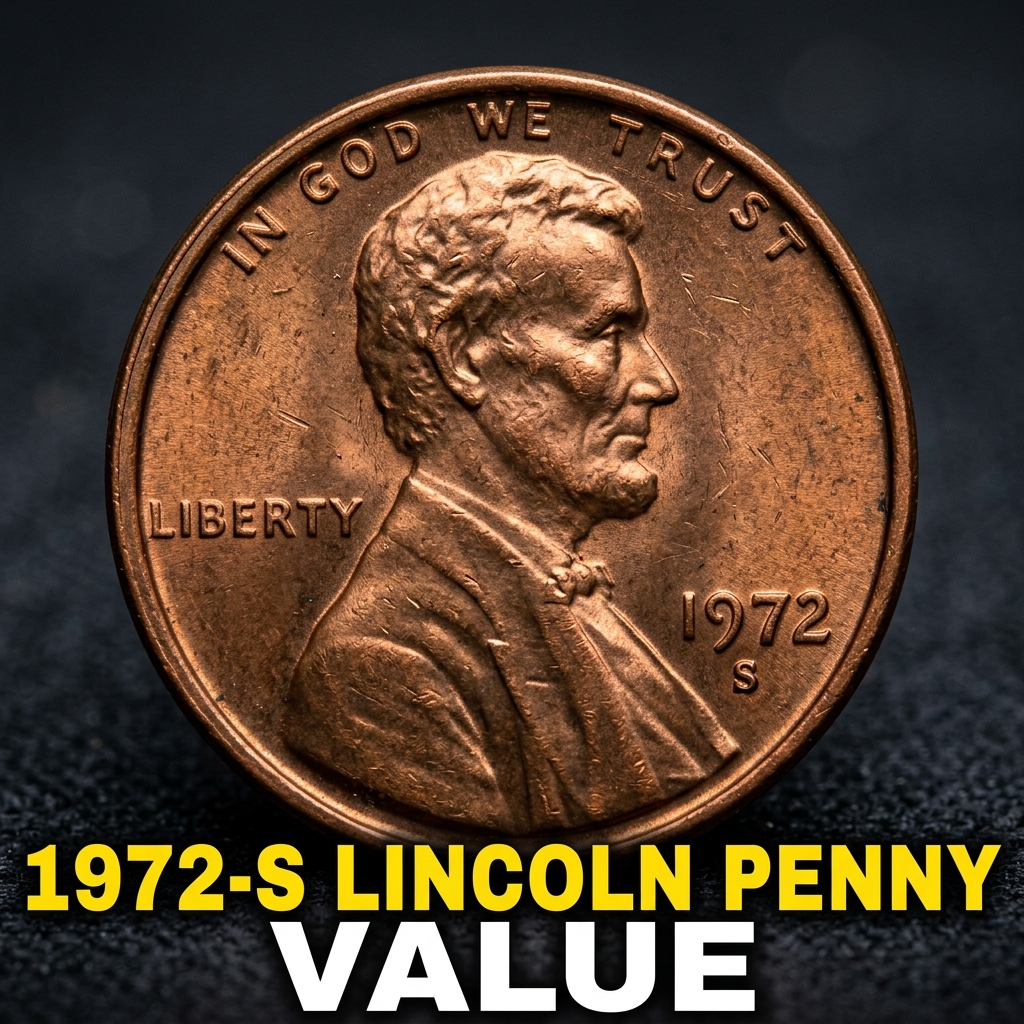
The 1972-S Lincoln Penny is worth anywhere from $0.05 in circulated condition to over $1,000 for high-grade proof specimens. If you just found a shiny penny with an “S” mint mark in your pocket change, you might be holding a small piece of San Francisco minting history that is worth significantly more than one cent.
Identifying Your 1972 S Mint Mark Lincoln Cent
To determine the value of your coin, you first need to confirm it was minted in San Francisco. Look at the date “1972” on the right side of Abraham Lincoln’s portrait. Directly underneath the date, you should see a small capital “S.” This letter indicates the coin was produced at the San Francisco Assay Office. During this era, San Francisco primarily focused on “Proof” coins intended for collectors, though they did produce some pennies for general circulation as well. If you are unsure about the details of your coin, using the best coin identifier app can help you confirm the variety and mint mark within seconds.
The 1972-S is unique compared to the Philadelphia or Denver strikes because of its lower mintage figures. While billions of pennies were made in the other cities, San Francisco struck fewer than 400 million business strike coins and about 3.2 million proof coins. This relative scarcity is what makes the “S” mint mark so exciting for everyday finders. If you want to track your collection digitally, the CoinHix app is an excellent tool to organize your finds and monitor market trends.
Differentiating Business Strikes and Proof Coins
When examining a 1972-S Lincoln Cent, you will likely find one of two types. The first is the “Business Strike,” which was intended for regular spending. These typically have a satin-like finish and may show signs of wear from being in circulation. The second type is the “Proof” coin. Proofs were specially struck using polished dies and planchets to create a mirror-like background and frosted details. Most proof coins were sold in plastic sets, but many have been broken out or accidentally spent over the years.
Collectors pay close attention to the current market prices for 1972-S Red Lincoln cents when they are in pristine condition. A business strike penny in a “Brown” (BN) or “Red-Brown” (RB) color is common, but a “Red” (RD) specimen that still looks like it just came off the press is highly sought after. If your penny is exceptionally shiny and the background reflects light like a mirror, it is likely a proof coin, which carries a higher floor value than a standard circulating penny.
Understanding the 1972 S Penny Value and Grading
The value of your 1972-S penny is almost entirely dependent on its “grade” or state of preservation. Coins that have been scratched, cleaned, or worn down by fingers lose value quickly. Professional grading services use a scale from 1 to 70. Most 1972-S coins found in change will grade as “Circulated,” while those found in original rolls are “Uncirculated.”
For those looking for a quick reference, the latest valuation data for the 1972 penny shows that even common examples are worth a small premium over face value. However, the real money is in the “Super Grades.” For example, a 1972-S Proof penny in a perfect grade of PR70 with Deep Cameo (DCAM) contrast can sell for hundreds or even thousands of dollars at specialized auctions. For the average person, using CoinHix can help you determine if your coin is worth the fee for professional grading.
| Condition / Grade | Business Strike (Circulated) | Business Strike (Uncirculated) | Proof Condition |
|---|---|---|---|
| Good / Fine | $0.02 – $0.05 | N/A | $0.25 – $0.50 |
| About Uncirculated | $0.10 – $0.25 | $0.50 | $1.00 |
| Mint State 63/65 | N/A | $1.00 – $15.00 | $5.00 – $20.00 |
| High Grade (MS67 / PR69+) | N/A | $100.00+ | $250.00 – $1,000+ |
Are There Rare Errors on 1972 S Pennies?
While the 1972 Philadelphia penny is famous for its “Double Die Obverse” (DDO) error where the date and lettering look doubled, the 1972-S is less known for major errors. However, collectors still hunt for minor “S” mint mark issues. These can include “Repunched Mint Marks” (RPM), where the “S” was punched into the die twice, or small die cracks known as “BIE” errors (where a small vertical line appears between the letters B and E in the word LIBERTY).
Identifying these micro-errors requires a magnifying glass or a high-quality camera. The CoinHix mobile app allows users to zoom in on high-resolution images to compare their coins against known error varieties. Finding a verified error on a 1972-S Lincoln cent can instantly turn a common coin into a treasure worth $20 to $50 or more, depending on the severity of the mistake made by the mint.
Q: Is a 1972 S penny made of real copper?
A: Yes, all 1972 Lincoln pennies are composed of 95% copper and 5% zinc. It wasn’t until mid-1982 that the U.S. Mint switched to copper-plated zinc cores. Because of the copper content, even a worn 1972-S has a “melt value” of about 2 to 3 cents.
Q: Does the “S” mean my penny is rare?
A: While the San Francisco mint produced fewer pennies than Philadelphia or Denver in 1972, with 376 million business strikes, it is not considered “rare” in circulated condition. However, it is less common to find in your change today than it was 30 years ago.
Q: Should I clean my 1972 S penny to make it worth more?
A: Never clean your coins! Using soap, polish, or chemicals can strip the original surface and significantly lower its value to collectors. A “cleaned” coin is often worth only its weight in copper, whereas an original, patinated coin maintains its numismatic premium.