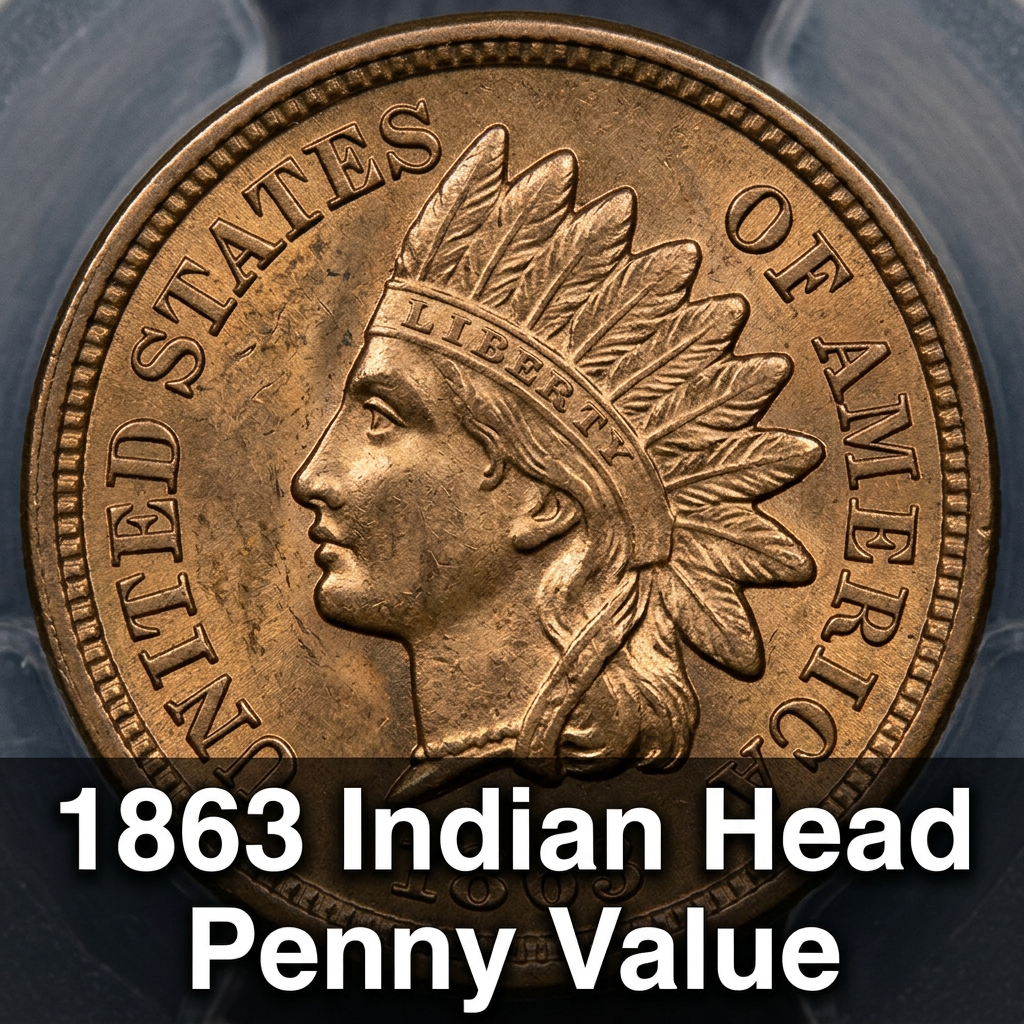
The 1863 Indian Head Penny is worth anywhere from $10 in heavily worn condition to over $300 or more in pristine mint state. If you’ve dug one of these out of an old jar or inherited it from a grandparent, you might be sitting on a surprisingly nice little find.
A Quick History of the 1863 Indian Head Penny
The 1863 Indian Head Penny was struck at the Philadelphia Mint right in the middle of the Civil War. The United States was under enormous strain, and coin hoarding was rampant — people were pulling copper and silver coins out of circulation because they didn’t trust paper currency. That means many 1863 pennies actually survived in better-than-average condition, tucked away in pockets and drawers and never spent.
The coin features Lady Liberty wearing a Native American headdress on the obverse, designed by James Longacre. The reverse shows a simple wreath and the words “ONE CENT.” It’s made of copper-nickel and has a plain edge.
If you’re not sure what you’ve got, using the best coin identifier app can help you quickly figure out the date, mint mark, and condition of your coin before you make any decisions about selling it.
How Much Is an 1863 Indian Head Penny Worth?
The value of your 1863 Indian Head Penny depends heavily on its grade — that is, how well-preserved it is. Coins that have been circulated for years look dull and worn, while uncirculated examples can show original luster and sharp detail.
Here’s a general value breakdown based on condition:
| Grade / Condition | Description | Estimated Value |
|---|---|---|
| Good (G-4) | Heavy wear, design visible but flat | $10 – $15 |
| Very Good (VG-8) | Major details clear, some flatness | $18 – $25 |
| Fine (F-12) | Moderate wear, decent detail | $28 – $40 |
| Very Fine (VF-20) | Light wear on high points | $45 – $65 |
| Extremely Fine (EF-40) | Slight wear, sharp details | $80 – $110 |
| About Uncirculated (AU-50) | Trace wear, most luster present | $120 – $160 |
| Mint State (MS-63) | No wear, light marks, strong luster | $200 – $300+ |
| Mint State (MS-65+) | Gem quality, exceptional eye appeal | $500 – $1,000+ |
For a more detailed look at 1863 Indian Head Penny prices across all mint state grades, including recent auction results, it’s worth checking a live pricing database so you’re working with real, up-to-date market data.
What Makes Some 1863 Pennies More Valuable Than Others
Not all 1863 Indian Head Pennies are the same. Beyond grade, there are a few specific things that can push the value higher — or lower.
Strike quality matters a lot. Some 1863 coins came off the press with sharp, well-defined feathers on the headdress and clear lettering, while others were weakly struck. A well-struck coin always commands a premium.
Color designation is another big factor for uncirculated coins. Grading services like PCGS and NGC classify copper coins as Red (RD), Red-Brown (RB), or Brown (BN). A Red example — one that retains its original bright copper color — is significantly more valuable than a Brown example of the same numeric grade.
Proof versions of the 1863 Indian Head Penny also exist. These were specially made for collectors with highly polished dies and reflective surfaces. A proof 1863 penny in top condition can sell for well over $1,000.
You can use CoinHix to quickly compare current market prices and see how recent sales have trended — it’s one of the smartest tools available for collectors at any level.
How to Check the Condition of Your 1863 Indian Head Penny
You don’t need to be a professional numismatist to get a general sense of your coin’s grade. Start by examining it under good lighting — natural daylight or a single directional lamp works well.
Look at the diamond on Lady Liberty’s ribbon: if it’s sharp and clear, your coin likely grades Fine or better. Check the feathers on the headdress — a worn coin will show flat, blended feather tips, while a higher-grade coin will have distinct separation.
Avoid cleaning your coin. This is one of the most common mistakes people make. Cleaning almost always reduces value because it leaves hairline scratches and removes original surface texture that collectors and graders look for.
For a professional opinion, you can submit your coin to PCGS or NGC for official grading. Or, for a fast first impression, CoinHix lets you scan and evaluate coins right from your phone, making it a great starting point before you invest in a formal submission.
Is the 1863 Indian Head Penny a Good Coin to Keep or Sell?
If your 1863 Indian Head Penny grades below Fine, it’s an enjoyable coin to hold but not a major financial asset. At that level, you’re looking at $10 to $40, which is still a nice return on something you might have found in a coin jar.
However, if your coin looks sharp, shows original copper color, and has strong detail, it could be worth having professionally graded. An MS-63 Red example recently sold at auction for over $300, and higher-grade examples can reach into the thousands.
Indian Head Pennies as a series are popular with collectors, which means demand stays steady. If you’re curious how the 1863 compares to nearby dates in the series, you can explore Indian Head Penny values by year to see how each date stacks up in today’s market — a helpful way to understand whether your specific coin is common or scarce relative to the broader series.
—
Frequently Asked Questions
Q: How many 1863 Indian Head Pennies were made?
A: The Philadelphia Mint struck approximately 49,840,000 business strike 1863 Indian Head Pennies, making it one of the higher-mintage years for the series. Despite the large mintage, high-grade examples are still scarce because most coins saw heavy circulation during the Civil War era.
Q: Does the 1863 Indian Head Penny have a mint mark?
A: No. All 1863 Indian Head Pennies were produced at the Philadelphia Mint, which did not use a mint mark on cents during this period. So the absence of a mint mark is completely normal and does not affect the coin’s value.
Q: Should I clean my 1863 Indian Head Penny before having it appraised?
A: Absolutely not. Cleaning a coin — even gently with a cloth — can significantly reduce its value. Professional graders can immediately detect cleaning, and a cleaned coin will always receive a lower designation than an original-surface example. Leave it exactly as you found it and let an expert evaluate it in its natural state.