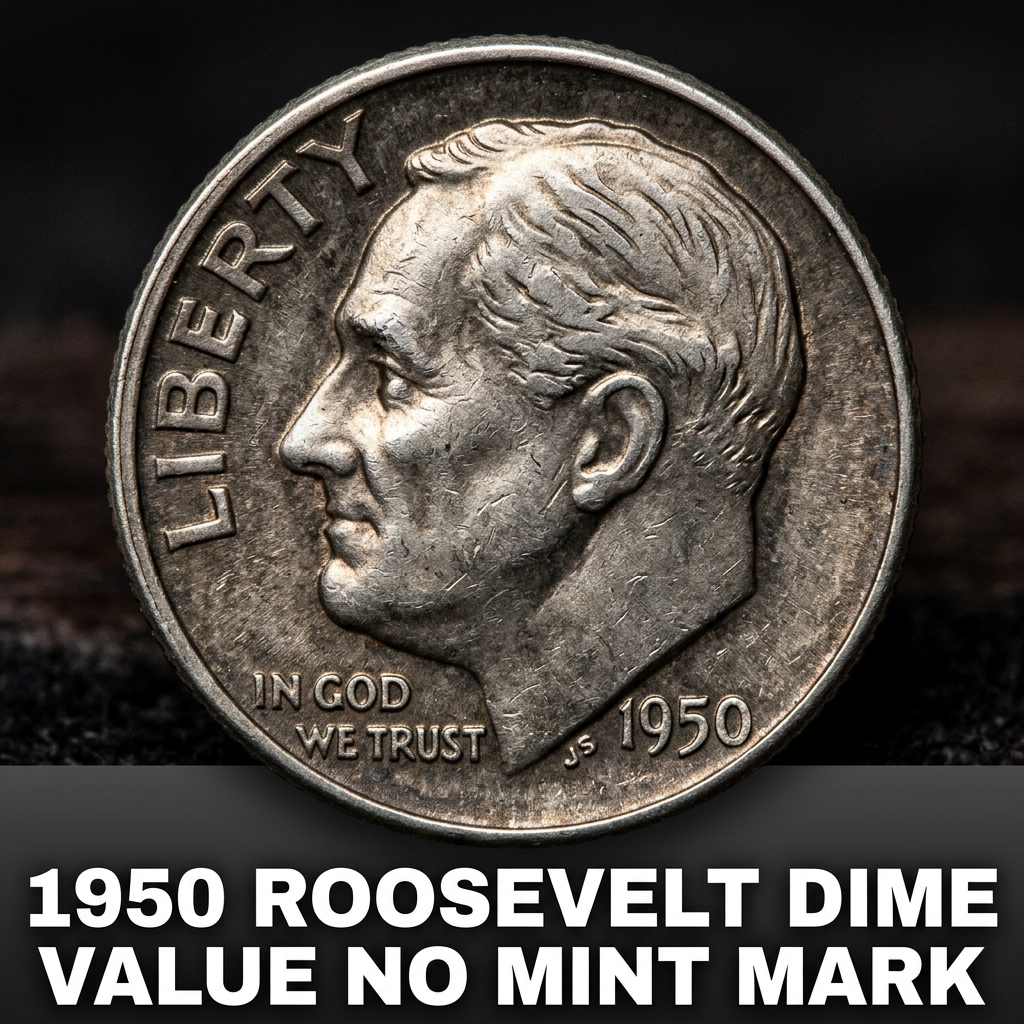
The 1952 Roosevelt Dime is worth anywhere from $2.50 in worn condition to over $600 in high-grade mint state. Finding one of these silver treasures in your change or an old jar is an exciting moment for any American, as it represents a piece of history that still holds intrinsic precious metal value.
| Condition | Estimated Value |
|---|---|
| Good / Very Good (Worn) | $2.30 – $2.75 |
| Fine / Extremely Fine | $3.00 – $5.50 |
| Uncirculated (MS60-MS63) | $8.00 – $15.00 |
| Choice Mint State (MS65+) | $30.00 – $600.00+ |
History and Specification of the 1952 Silver Roosevelt Dime
The Roosevelt Dime was first introduced in 1946 to honor President Franklin D. Roosevelt following his passing. By 1952, the design was well-established in American commerce. Unlike today’s dimes, which are made of copper and nickel, the 1952 dime is composed of 90% silver and 10% copper.
This silver content is the primary reason why even a heavily worn 1952 dime is worth significantly more than its ten-cent face value. If you are unsure if your coin is authentic, using the best coin identifier app can help you confirm its metal composition and date.
In 1952, the Philadelphia Mint produced nearly 100 million of these coins. Because they were produced in such high volume, they are not considered “rare” in the traditional sense, but they are highly sought after by stackers for their silver weight and by collectors for high-grade sets.
The 1952 dime weighs approximately 2.5 grams and has a diameter of 17.9 millimeters. When you hold a 1952 dime, you are holding roughly 0.07234 troy ounces of pure silver, which creates a “melt value” baseline that fluctuates with the silver market.
Understanding the Meaning of No Mint Mark on a 1952 Dime
Many new collectors get excited when they see a coin with “no mint mark,” thinking it might be a rare error. In the case of the 1952 Roosevelt Dime, the absence of a mint mark simply means the coin was struck at the Philadelphia Mint. At that time, Philadelphia was the main US Mint facility and generally did not use a mint mark on its coins.
If you are looking at your dime and don’t see a small ‘D’ (for Denver) or ‘S’ (for San Francisco) above the date or near the torch on the reverse, you have a Philadelphia issue. This is the most common version of the 1952 dime.
While common, these coins are essential for completing a late 40s and early 50s silver set. If you are curious about how your specific Philadelphia coin compares to others, checking the 1952 Roosevelt Dime MS grade pricing can give you a better idea of the premium collectors pay for well-preserved specimens.
Using a tool like CoinHix can help you distinguish between a standard Philadelphia strike and more valuable varieties that might be hidden in plain sight.
Determining the Grade and Condition of Your 1952 Dime
Condition is the single most important factor when determining the value of a 1952 Roosevelt Dime with no mint mark. Most coins found in old piggy banks or “junk silver” bags are in “Circulated” condition. This means they have visible wear on the high points of Roosevelt’s face or the torch on the reverse.
“Uncirculated” coins, also known as Mint State (MS), are those that never made it into public pockets. These coins retain their original “mint luster”—the satiny sheen created during the striking process. A 1952 dime in MS67 condition can be worth hundreds of dollars, while a standard worn one is worth its silver weight.
| Grade Designation | Detailed Appearance |
|---|---|
| Very Good (VG-8) | Heavily worn; Roosevelt’s hair is smooth; outlines are clear. |
| Extremely Fine (XF-45) | Light wear on the ear and high hair points; original detail mostly present. |
| Uncirculated (MS-63) | No wear; attractive luster; may have small contact marks or “bag marks.” |
| Full Bands (FB) | The horizontal bands on the torch are fully separated and distinct. |
The “Full Bands” Premium for 1952 Dimes
For serious Roosevelt Dime collectors, the “Full Bands” (FB) designation is the holy grail. This refers to the horizontal bands at the top and bottom of the torch on the reverse of the coin. Because the dies often wore down, many 1952 dimes lack crisp definition in these areas.
A 1952 Philadelphia dime with Full Bands is considerably rarer than one without. Collectors are willing to pay a massive premium for this sharp detail. For instance, a standard MS66 1952 dime might sell for $40, but a 1952 MS66 with Full Bands could easily fetch over $150 at auction.
To see how these tiny details change the price, you can browse a detailed 1952 dime value chart which breaks down the differences between standard strikes and FB specimens. Many hobbyists use CoinHix to zoom in on these torch bands to see if they have hit the jackpot.
1952 Dime Varieties and Rare Errors to Look For
While most 1952 dimes with no mint mark are standard issues, there are a few errors and varieties that can make a coin more valuable. Doubled Die varieties are the most popular among “cherrypickers.” A Doubled Die occurs when the hub strikes the die twice at a slightly different angle, creating a ghosting or doubling effect on the letters or date.
Look closely at the “LIBERTY” inscription or the date “1952” with a magnifying glass. If you see clear overlapping lines, you might have a Doubled Die Obverse (DDO). While not as famous as the 1955 penny, a verified 1952 DDO dime can still command a premium from error collectors.
Other errors to watch for include “clashed dies,” where the images from the front and back of the coin seem to bleed through to the other side, or “off-center strikes” where the design is not centered on the silver planchet. These errors turn a common $3 silver coin into a unique collector’s piece worth $20 to $100 or more.
Is the 1952 Dime a Good Investment?
If you are looking for a way to start investing in precious metals without spending thousands of dollars, the 1-952 Roosevelt Dime is a fantastic entry point. Because it is 90% silver, its value will never drop below the price of silver bullion. This provides a “safety net” for your investment.
Furthermore, as older silver coins are melted down or lost to history, the remaining 1952 dimes become more scarce. Unlike modern denominations, these coins have a dual demand: from people who want to own physical silver and from coin collectors who want to preserve American history.
Before selling your collection, it is always wise to use an app like CoinHix to keep an eye on the current spot price of silver. Since the value of your 1952 dime is tied to the market, knowing the daily rate ensures you get a fair price from a coin dealer or pawn shop.
| Historical Context | Impact on Value |
|---|---|
| Post-War Economic Boom | High production means many circulated coins exist. |
| 1964 Silver Phase-out | Most silver dimes were pulled from circulation after 1964. |
| Rising Silver Market | Increases the “melt” floor price of every 1952 dime. |
FAQ
Q: Why does my 1952 dime have no mint mark?
A: A 1952 dime with no mint mark was minted in Philadelphia. During that era, the Philadelphia Mint did not use a “P” mark on dimes. It is a standard feature of the coin and does not necessarily make it more valuable than the Denver or San Francisco versions.
Q: How much silver is in a 1952 Roosevelt Dime?
A: Each 1952 dime contains 0.07234 troy ounces of pure silver. It is made of 90% silver and 10% copper. If silver is priced at $25 per ounce, the silver value of the dime alone is approximately $1.81.
Q: Where can I sell my 1952 silver dime?
A: You can sell your silver dimes to local coin shops, reputable bullion dealers, or through online auction sites like eBay. For high-grade or error coins, consider professional grading services like PCGS or NGC before selling to maximize your profit.
Q: What is a “Full Bands” 1952 dime?
A: “Full Bands” is a designation given by grading services to Roosevelt dimes that have a fully detailed, crisp torch on the reverse. The horizontal lines at the center and ends of the torch must be completely separated. These coins are much more valuable to collectors.
Q: Can I find a 1952 silver dime in my pocket change today?
A: While it is extremely rare, it is still possible. Most silver was removed from circulation in the late 1960s, but occasionally old collections are spent by people who don’t realize their value. Always check your change for any dime dated 1964 or earlier!