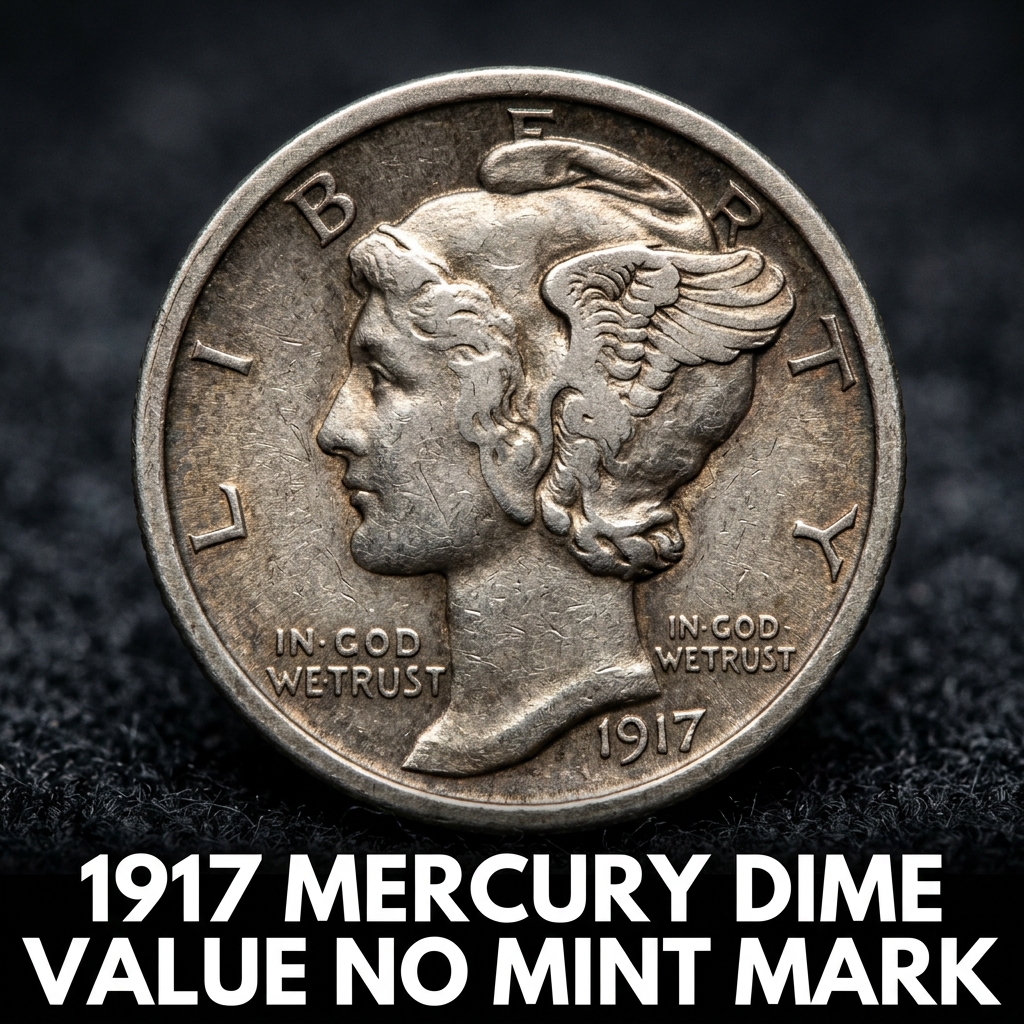
The 1917 Mercury Dime with no mint mark is worth anywhere from $3 in heavily worn condition to over $1,200 in high-grade uncirculated condition. If you have found one of these beautiful “Winged Liberty” coins in a jar of change or an old collection, you are holding a piece of American history from the World War I era.
History and Identifying the 1917 Philadelphia Mercury Dime
The Mercury Dime is widely considered one of the most beautiful coins ever minted by the United States. Designed by Adolph A. Weinman, the coin actually depicts Lady Liberty wearing a winged Phrygian cap, which was meant to symbolize freedom of thought. However, the public mistook her for the Roman god Mercury, and the name stuck.
In 1917, the Philadelphia Mint produced over 55 million of these dimes. Because these coins were struck in Philadelphia, they do not feature a mint mark. If you look at the reverse (back) of the coin, near the bottom left by the olive branch, you will see a blank space. This confirms yours is a Philadelphia issue. Finding old coins like this is exciting, and if you want to identify your coins instantly, using the best coin identifier app can help you determine exactly what you have in seconds.
Since these coins were used heavily in daily commerce for decades, most survivors are quite worn. However, even a worn 1917 dime is valuable because it is composed of 90% silver. If you are unsure about the variety or condition of your coin, you can always use CoinHix to get a better sense of its market standing.
Understanding the Value and Grading of Your 1917 Dime
When determining the value of your 1917 Mercury Dime, the most important factor is its physical condition, or “grade.” Most coins found today are in “Good” or “Very Good” condition, meaning the feathers in Liberty’s cap are blurred and the vertical lines on the fasces (the bundle of rods on the back) are worn away.
As the condition improves, the 1917 Mercury Dime value in Mint State climbs significantly. Collectors are especially looking for “Full Bands” (FB) specimens. This refers to the horizontal bands holding the fasces together on the reverse; if they are fully separated and distinct, the coin is worth a massive premium.
For the average person, checking the 1917 dime value guide is the best way to see where your coin falls on the spectrum. Even if it isn’t a museum-quality piece, it still holds intrinsic silver value that far exceeds its ten-cent face value. Keeping track of your collection’s worth is easier than ever with CoinHix, which provides real-time updates on market trends.
| Condition / Grade | Estimated Market Value |
|---|---|
| Good (G-4) | $3.00 – $4.50 |
| Fine (F-12) | $6.50 – $9.00 |
| Extremely Fine (XF-45) | $25.00 – $35.00 |
| Uncirculated (MS-63) | $85.00 – $110.00 |
| Choice Uncirculated (MS-65+) | $250.00 – $1,200.00+ |
Key Characteristics and Silver Content
The 1917 Mercury Dime is part of a series that ran from 1916 to 1945. It weighs 2.5 grams and is made of 90% silver and 10% copper. Because of its silver content, its “melt value” provides a price floor. Even if the coin is so worn that the date is barely visible, it will always be worth at least its weight in silver.
When you examine your coin, look for the “AW” monogram on the lower right side of the obverse. This is the artist’s initials and is not a mint mark. The absence of a letter near the bottom of the reverse confirms it was minted in Philadelphia. If you see a small “S” or “D”, the coin was minted in San Francisco or Denver, respectively, and would have a different value.
Many people who find these coins are surprised by how small and delicate they are. Despite their size, they are a favorite among investors. If you’re building a collection or just curious about a single find, CoinHix can help you organize and value your silver holdings effectively.
Where to Sell Your 1917 Mercury Dime
If you find that your 1917 Mercury Dime is in exceptional condition, you might consider selling it to a coin dealer or through an online auction. Professional grading by services like PCGS or NGC is usually only worth the cost if the coin is in Mint State (uncirculated). For common, worn examples, local coin shops or silver buyers are the easiest way to cash in.
Before selling, always research recent realized auction prices rather than just looking at “asking” prices on sites like eBay. The market for Mercury dimes is very active, and there is always demand for early dates like 1917. Understanding the nuances of coin grading can be difficult for a beginner, but modern tools have made the process much more accessible for the “everyday” treasure hunter.
Q: Is a 1917 dime always made of silver?
A: Yes, all Mercury dimes minted in 1917 are composed of 90% silver. They do not contain any manganese or nickel like modern dimes.
Q: Where is the mint mark on a 1917 Mercury dime?
A: The mint mark is located on the reverse side, to the left of the base of the fasces. If that area is blank, the coin was minted in Philadelphia and has “no mint mark.”
Q: Should I clean my 1917 Mercury dime to make it worth more?
A: No! Never clean your coins. Collectors prefer the original patina or “tarnish.” Cleaning a coin with chemicals or clothes creates tiny scratches that significantly reduce its numismatic value.